Saturday, June 13, 2015

A day in Parnu

We were having a full day in Parnu and two nights, so booked an apartment.  It was in a large old wooden house, with uneven floors and a great stove going between two bedrooms.  The owner, Tamara, said her son complained about her living in an old Russian house but it certainly had its appeal.


Tamara looked after her guests and did several loads of washing in her machine for us,  which we could hang out in her garden outside.  She also had a little campsite for walkers and campers in her garden, with a notice saying if not one is around, put up your tent and pay later. The address is 18 Esplanaadi if any cyclists want to visit.  


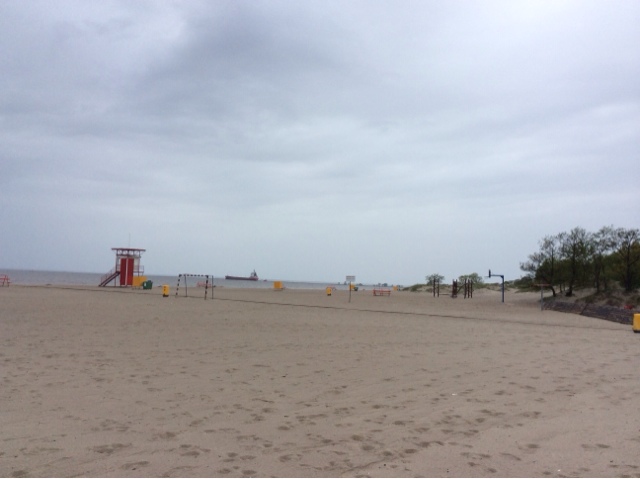
Parnu is a beach resort where once people went for mud cures.  The black mud of that area is supposed to have curative powers, though I never discovered what they cured. The old building for mud treatment is now a posh hotel where you can have spa treatments, with saunas of various types and massages, etc., arranged, it said, on Roman ideas. We passed on.  By the time we got to the beach it was drizzling and was a typical beautiful sandy beach on a cold wet day out of season.


Places marked as worth visiting were not open, an Orthodox Church was not open during the week until June, a modern art gallery was changing their display but the general town museum, which our guide book was a little disparaging about turned out to be very interesting, starting with prehistoric finds, including a pendant carved iin human form out of animal bone, from 7500 BC and moving on to the changing dominating powers in Estonia.  It has been independent for little of its history.


To Parnu

Monday 25th May.  A nice ride to Parnu, with the sun shining and the wind sometimes behind us.  The countryside near the coast is often a National Park, either because it is very boggy or because it was used by the military in Soviet times and is therefore mainly unspoilt by human habitation.  We passed through forests and the Lindi Bog, a protected area, where there was a watch tower.  We saw no animals but there was a track going through the water and over dryer land to a hole.  Whose hole?  The information board said foxes, raccoons and deer lived there.


All the way along we are often cycling through forests.  Where the road is narrow and winding, the forests are beautiful and occasionally you see wild animals but where the road is wider and straight, and the verges have been neatly cut back, forests can get awfully boring.  Just on and on, miles of the same.


Going back a bit to the islands. The first one Hiiumaa, seemed much wilder and less developed than the larger Saaremaa. Hiiumaa had more boggy ground, so was less cultivated. There we saw deer, a pine martin and a hare.  On Saaremaa there was much more agriculture.  

Generally, throughout our journey, in all the countries, there have been people tending their land. Lawns are mown and there are shrubs and attractive flower beds.  At the moment there are a lot of red tulips out.  The sound of strimmers and mowers is very noticeable, especially at the weekends.  There are also plenty of allotments, all very neatly kept.


Wednesday, June 10, 2015

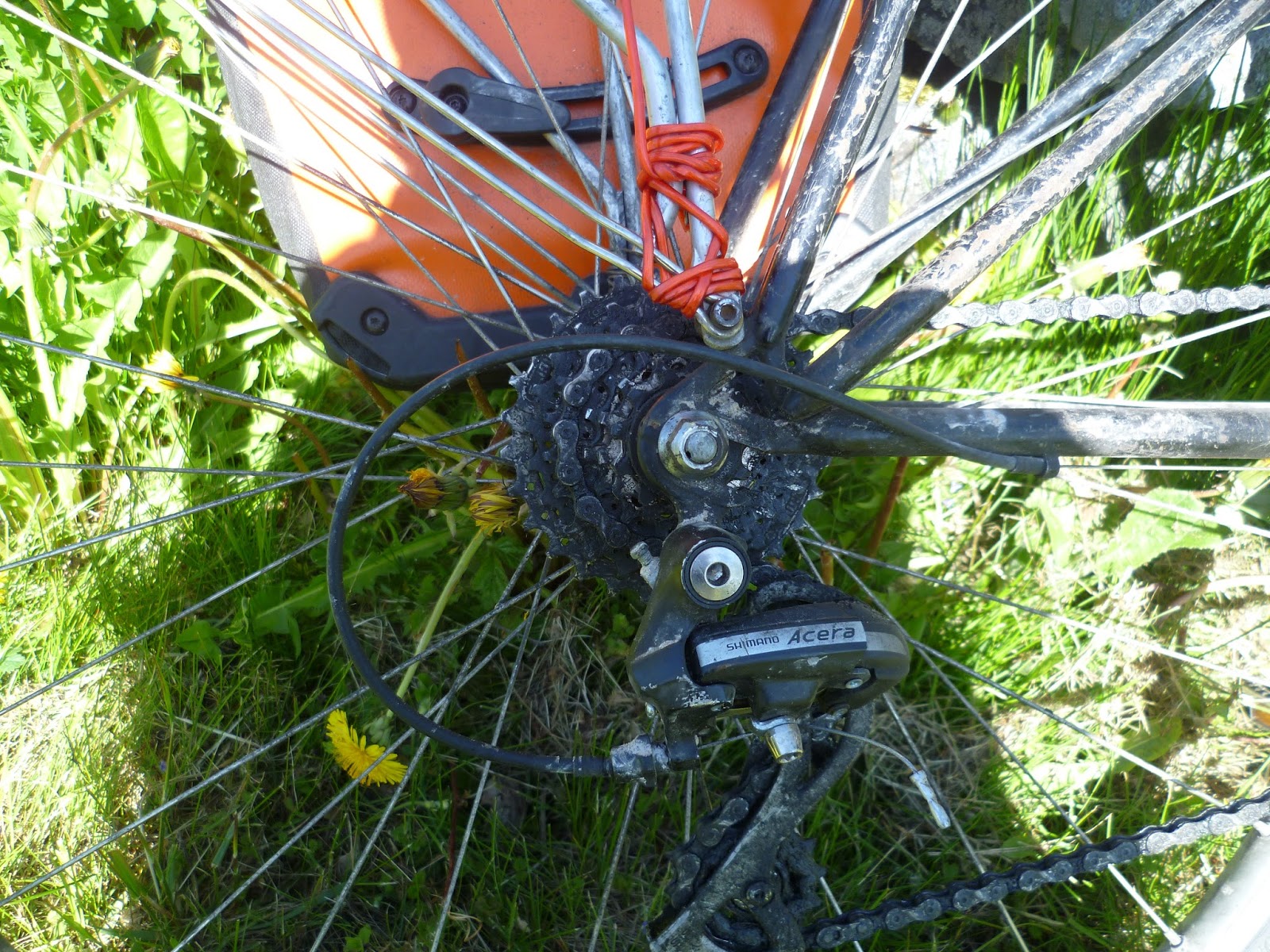
Lashing (of cords and ropes)

When Katherine's pannier rack broke, the upright rod taking all the weight down to the frame above the wheel axle snapped.  George managed to bind it so that the rod remained in place, as shown.  This mend lasted through 2 days of cycling, including along dirt roads.  George could reasonable claim his lashing badge.


Monday, June 8, 2015

Some pictures to go with the last post.

Pictures and a few extra comments.  On loading the bikes at the riding place, my back carrier snapped. Fortunately George's scouting skills came into play and he did a superb knotting/lashing job which was still holding fine several days later when we got to a bike shop to replace it. The photo of the actual knot is on the iPad but not on the selection the blogger has offered me. Where has it gone? These things remain mysteries.


Tom's account of the accommodation that night was a little watered down.  We had cycled quite far and one is never certain of actually finding the places marked on the map.  The path to where the campsite was marked was guarded by a sign of beware the fierce dog. We took the point and when on down the hill to where the cabins were marked, 2.5kms down a fairly rough dirt road and passed some wild boar. The place we found had no sign of anyone, the house was lived in but looking through the window seemed rather chaotic and there was no phone number or welcome sign or anything. On the side of the house facing he sea, was a glass conservatory area that must have once been a dining area and outside a big wooden terrace now rotting.  Inside were lots of potted plants, an array of furniture and a very beautiful cat.  In front of the terrace was mown grass and beyond that facing the sea were the huts.  A row of clean huts with beds, a rotting wooden pathway and at the end a very expensive looking brand new shower, with a visa/master card sign on the door.  The huts had windows facing the house with blinds, but glass doors with no blinds facing the path and the sea. The only protection inside was a flower painted onto the glass. Besides ordinary flowers like tulip, there was cannabis and the huts were painted in rather psychodelic colours.  Just what sort of place was this?  

No one was prepared to cycle the 2.5kms up the path and past the boars to see if the notice at the top had a phone number, so we just settled in and hoped we could sort it out in the morning. I must say I was a little uneasy, particularly as the doors had no keys in the locks.

At about 1.30, I was awoken to hear Tom talking with a man who had come in. The conversation seemed to be going something like Tom giving the explanation that we had found no one around and were going to come up to the house in the morning to pay, and he hoped that was alright.  There was a moments silence and then a long drawn out "No" from the man.  There then followed a conversation about when Tom should come up to the house and persuaded him that the morning would be alright. The man left having turned the outside lights on.  I left it a respectable time before admitting I was awake and a little longer before visiting the toilets.  There was now a light on outside each cabin.  Some were red and some were white.  I hoped this had no significance.  My sleep after that was interrupted by dreams of whole families arriving to stay in the hut we were in.  In the morning we decided to leave quickly and have breakfast along the way.  At the house a man came to greet and and beckoned us in.  He seemed to have only one word of English, "coffee".  And there it was a table laid for three breakfasts and coffee.  Communication was through Google translate.  He was very pleasant and it seemed a perfectly respectable place, if a little casual in its upkeep.  There was a fairly large birdcage at one end of the main room with various parakeets and other birds; and there was the very friendly cat. Was he the same man who had come the night before? None of us knew.  

It was a wild lonely place and rather beautiful, apart from rotting verandas.


From Muhu nearly to Parnu

We left the riding place after breakfast.  It was quite close to the ferry to the mainland.  We had a timetable, though when we turned up the times were different; no matter as the boats were frequent.  On the ferry, breakfast #2.  Noticed an enormous barge full of big logs saying "Sweden" on the side and moving slowly Northwards behind a tug.  To IKEA?  Probably not!  On the other side, we took a minor road, as specified on the cycle route, which  crossed a preserved marsh areas and then took a dirt road until it reached a bigger, well surfaced, south bound  main road. 

Very little traffic, no undue wind problem, so cycling not too bad.  But it went on and on!  Some breaks; lunch in a bus shelter, and the bus turned up; visit to a museum which was a manor house with accumulated this-and-that over many years.  But we did get to a village where our route guide said there was camping.  The village had a map posted up, marking every house with the name of the family living there,  but also camping by the sea and a picture of a row of chalets.  We found the road leading to this and it was a long descent, past a farm and past where George saw some wild pigs - they had run away by the time I got there, and to this campsite.  No sign of anyone, but indeed a row of chalets each with two beds and each unlocked.  So we settled down into two of them.

In tnhe middle of the night a gentleman opened the chalet where Katherine and I were sleeping.  A language problem, but I said slowly in English (obviously; my Estonian allowed nothing else!) that we would come to the house in the morning to pay.  Not sure this was really understood, but he went away and we did report in tnhe morning - in a post to come!

No photos here, as I do not have any on this computer, but Katherine is going to add some.

Friday, June 5, 2015

On to the island of Muhu


Saturday 23rd May.  Sunny day with a cold but not icy wind, mainly behind us.  We diverted down a dirt road to find another of these very old stone churches at Poide. This time we were successful and it was open.  It had been struck by lightening in 1940 and the steeple and roof was burnt.  The roof must have been repaired but not the steeple and the tower that was left had a large crack in it. In Soviet times it ceased to be used as a church and hay was stored in it.  Now it is being used as a church once again and starting to be restored.  There is a lot of work to do, but it has a stark beauty as it is.  


There was also the remains of a fort built by theTeutonic Orderburg.  That doesn't seem to have lasted as long, there were just a few stones left to mark its place.

Returning to the main road, we went over a cobbled stretch with beautifully shaped and laid cobbles.  Poide is now tiny but looking at the cobbles and the size of the church, it must have once been quite important.

Next we went over the causeway to the island of Muhu.  Here the weather was not a kind and we had a strong wind against and to the side of us (yes winds can come from more than one direction when you are cycling. They gust around)  It was hard work for 4kms and when a team of lorries came in the opposite direction, I (Katherine) just had to stop.  The causeway was first built in the late 1800s and has been enlarged and improved many times since.  The downside has been that it disrupted the spawning routes of the fish, so fish were no more. But they wouldn't have thought about that in those days.  Probably not much different now.  We had another diversion to find an ostrich farm with cafe. Yes it was there but not open in May. However the campsite we wanted was open and very welcoming. It was a horse riding establishment,breeding horses and offering horse riding holidays.  There was a party of Finns there, so the sauna was booked out. However, there was also a large dining room with a log fire and buffet meals.  We pitched our tents and settled happily into the room with food and log fire. There were pictures all round the room about the area and the mystical properties given to the stones and groves in ancient times, practices not entirely abandoned.  There was also a picture of Martin, pouring oil on a fire to appease the spirit of an oak tree that was about o be cut down and placed in the dining room.


Thursday, June 4, 2015

On to Kaali

Kaali is a place where a meteorite fell about 7000 years ago.  It left a large crater, now with a lake in it and a number of smaller ones. It's fall is incorporated into folk legends, but we never found out what they were. 

 Generally this was a pleasant day if cycling with the wind behind is much of the time.  We did spend some time trying to find an old church built out of local dolomite.  We finally got it signposted 5km back the way we had come.  We had spent enough time looking already, so did not attempt it again.  Churches are often locked anyway.

We had booked somewhere to stay earlier and found that it was above the museum of the crater.  This meant we had access to the museum, which was otherwise closed.  We were the only ones there and were able to enjoy the facilities of a large dining room, a sauna and the keeping of the museum key.